2026-27 Global Change Research Fellow
PhD Student, Center for Geospatial Analytics within the College of Natural Resources, North Carolina State University
Advisor: Dr. Aaron Hipp
About You
What do you study?
My studies intersect social and environmental sciences. Parks and protected areas can provide an avenue for human to nature connection as well as human to human connection. They can help ease environmental stressors by providing areas with cleaner air and cooler temperatures while also providing people with mental and physical health benefits. I enjoy learning about how people interact in parks and protected areas and ways to improve the experience. I am working to understand these more and how we can make parks accessible to everyone of all socioeconomic backgrounds.
What influenced you to go into this field of study?
Growing up on the west coast, I was fortunate to spend many of my summers visiting various National and State Parks. These outdoor spaces shaped my worldview and provided me with perspective on the flow of the natural world. I became interested in this field of study as I was learning more about the benefits that outdoor recreation can provide but also the inequities that some face in regard to parks and protected areas. Everyone I have met throughout my academic journey from those I worked with during my undergraduate studies at Oregon State and those more recently at the University of California, Irvine. They have all shaped my outlook on science and have encouraged me to pursue the research I enjoy and find value in.

What do you think is the most pressing issue related to global change?
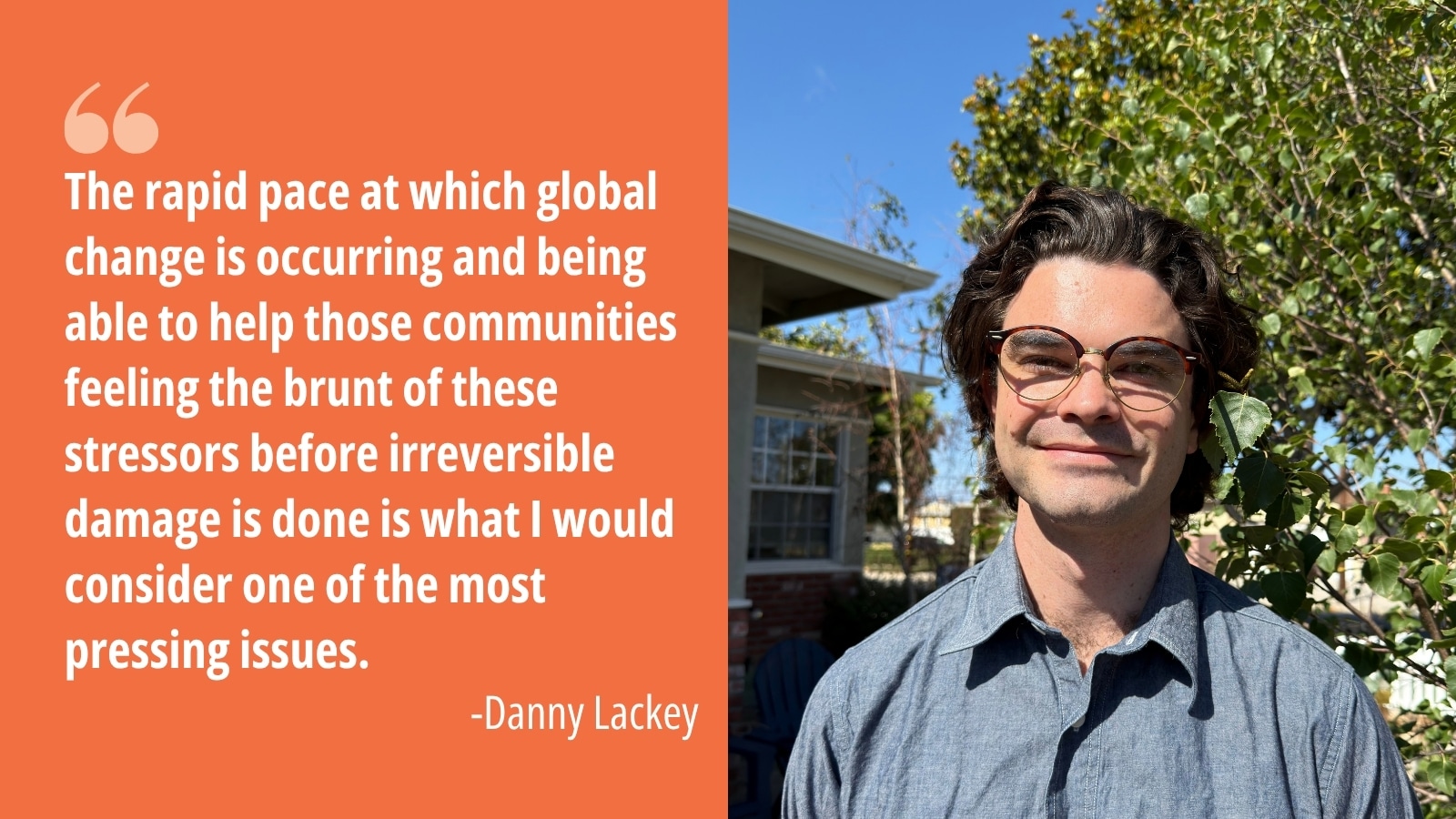
Global change is not felt equally across the world; some communities are at a greater risk than others. It seems like year after year there are new challenges that need addressing while others keep worsening. The rapid pace at which global change is occurring and being able to help those communities feeling the brunt of these stressors before irreversible damage is done is what I would consider one of the most pressing issues.
About Your Research
What is the most important thing that you’ve learned?
I am still in my first year, so I have not started working on my dissertation just yet. To prepare, I have been doing literature reviews, attending many webinars, panels, and guest lectures to keep current on the ongoing research. I am new to the Southeast region so I have been trying to explore the area and meet as many people as possible to gain an understanding of the communities I now live in.
Who will benefit from your research?
My research will benefit city planners, land developers, nonprofit organizations and researchers, as well as local communities. Parks can be used as a tool to mitigate environmental stressors within local communities and can also serve as hubs for social connections that strengthen communities. Parks in some cases can also benefit wildlife by providing habitat and act as corridors to larger ecosystems.
How would you describe your research to a 3rd grader?
Getting outside is healthy for everybody, and everybody should have access to a park. I study how we can make this possible in a way that helps people and helps the environment.
About Your Global Change Research Fellow Experience
How do you expect the SE CASC Global Change Research Fellows Program to impact you and your work?
I love working with very interdisciplinary teams, this cohort of global change fellows has a very wide range of research experiences and interests. I am looking forward to getting to know people who are experts in fields that I am not and being able to work together on projects. The fellows program will allow me to build my own skills and give me a network of people to collaborate with later in our research careers.
What advice would you give to a student that is interested in getting involved in your field?
It might be a cliche, but networking has been crucial for me. Not only meeting new people but staying in contact with those you have worked with previously. I found NC State and SE-CASC through faculty I worked with back in my undergrad. Don’t be afraid to cold-call or cold-email people either, it is all part of the process, and most people will be excited to learn about you and your interests.
What has been the most rewarding part or your favorite part of being a SE CASC Global Change Research Fellow?
As someone new to the area, it has been really exciting getting to meet new people and especially ones that have a shared interest in trying to make the world a better place. This program pulls people from all across the Southeast and I am especially excited to be able to meet and work with everyone this winter during our field intensive!
Is there anything else you would like to share?
Don’t be too hard on yourself if you ever feel lost when working in research. The nature of the job is to discover or understand the unknown. You won’t have all the answers right away and that is okay.
This article was originally posted by the Southeast Climate Adaptation Center. Learn more about the Global Change Research Fellows program.
- Categories:


