What is a Ghost Forest? An Expert Explains
Stands of dead or dying trees in coastal areas are expanding rapidly. Professor Marcelo Ardón explains why this ecological transition is happening, what can be done to slow it down, and more.
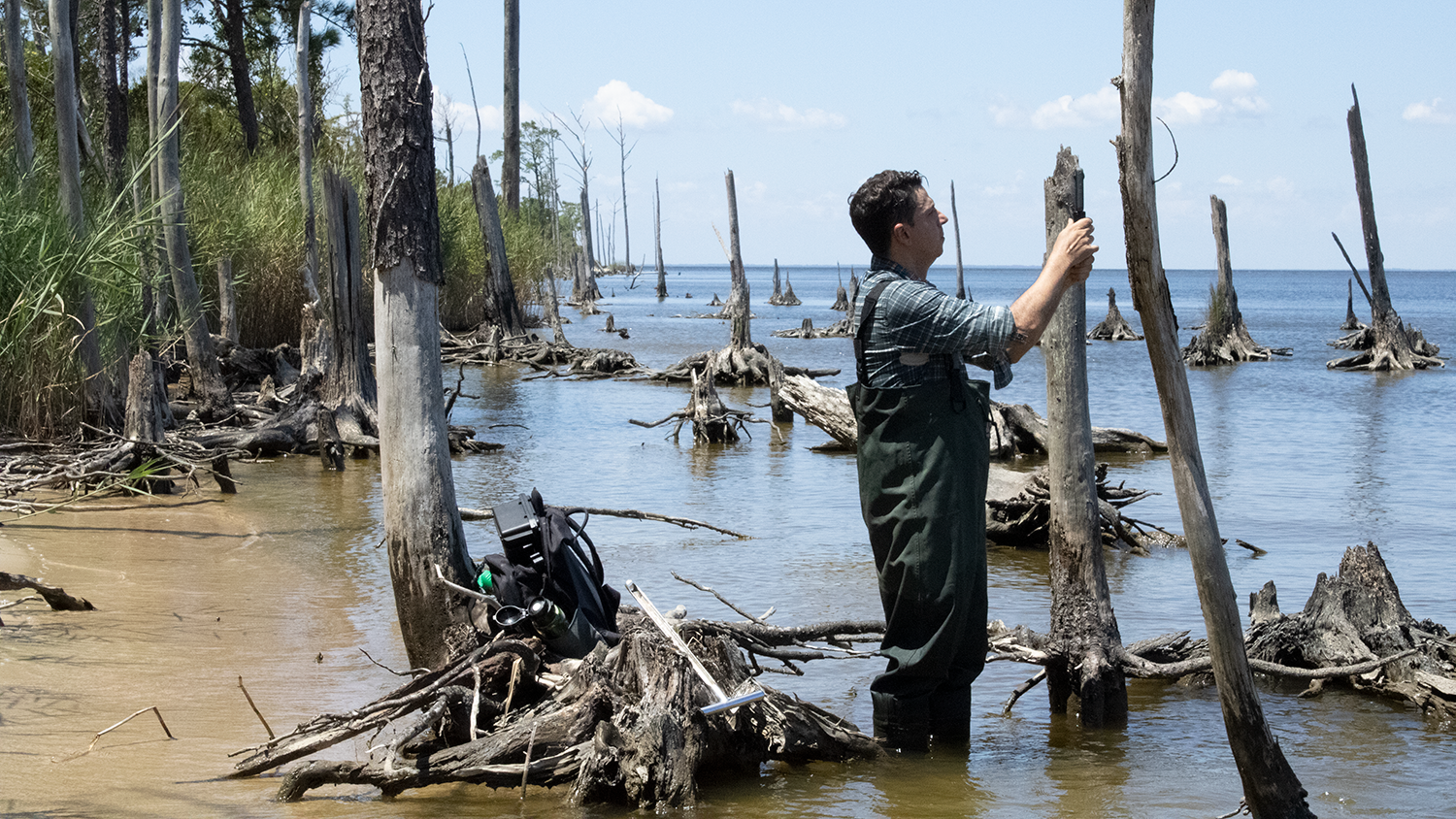
As rising seas push saltwater farther inland, coastal forests and wetlands are slowly being transformed into stark landscapes of bleached trunks, flooded roots and vanishing canopies.
These so-called ghost forests are a visible sign of a changing shoreline, where once-thriving hardwoods and evergreens are giving way to salt-stressed, dying trees.
Marcelo Ardón, a professor in the Department of Forestry and Environmental Resources at North Carolina State University, is at the forefront of efforts to study how ghost forests spread and impact coastal ecosystems, particularly along the Atlantic Coast.
“Ghost forests are occurring all along the Atlantic Coast, from New Jersey to Texas,” said Ardón, an ecologist whose research focuses on the biogeochemistry of wetlands and streams. “Most studies agree that there has been an acceleration of ghost forest creation in the last two decades.”
Through his research, Ardón offers a deeper look at the story behind ghost forests: how they form, why they are spreading, how they are reshaping coastal ecosystems and what they may reveal about the future of the coast.
Origin and Meaning of the Term “Ghost Forest”
The term “ghost forest” refers to the eerie appearance of dead or dying trees that remain standing in forested wetlands and upland forests inundated by saltwater.
“As these ecosystems turn into marshes, the trees lose their leaves, lose their bark and can remain standing for up to a decade. The standing dead trees are eerie looking from a distance, and thus that is where the term ‘ghost forest’ comes from,” Ardón said.
Primary Cause of Ghost Forest Formation
Saltwater intrusion creates a ghost forest by killing trees. When saltwater enters the soil, the high concentration of salt makes it harder for tree roots to absorb water, leading to dehydration. It can also cause salt to build up in the tree, interfering with its ability to absorb important nutrients.
As a result, leaves may turn brown and fall off, photosynthesis decreases and the tree becomes weaker. If salt exposure continues for a long time, the roots and other tissues can be severely damaged, eventually causing trees to die.
Stages of Ghost Forest Transition
Healthy wetland or forest: The cycle begins with a forested wetland or upland forest of trees adapted to freshwater conditions.
Saltwater moves inland: Sea-level rise and frequent flooding bring more saltwater into these ecosystems.
Trees become stressed: Increasing salinity and prolonged flooding disrupt trees’ ability to take up water and nutrients.
Trees die: Continued exposure to saltwater and flooding eventually kills trees, leaving behind bare, standing trunks.
Ghost forest emerges: Dead trees can remain standing for up to a decade, creating the characteristic ghostly landscape.
Historical Roots of Ghost Forests
Ancient cycles: Over millions of years, sea levels rose and fell with the coming and going of ice ages, causing forests and marshes to shift along the coast and creating and eventually erasing ghost forests.
Early scientific study: While botanists and naturalists observed dead coastal trees as early as the mid-19th century, scientists first began formally tracking and studying ghost forests in the 1920s.
Growing footprint: What was once observed in relatively isolated areas is now being documented across larger stretches of coastline as ghost forests become increasingly common.
Factors Driving Ghost Forest Expansion
A combination of factors related to climate change and human development is driving the spread of ghost forests:
Rising sea levels: As the climate warms, oceans expand and melting land ice adds water to the ocean. Higher seas mean that high tides and storm surges can push saltwater further inland.
More frequent flooding: As coastal flooding becomes more common, freshwater forests are exposed to saltwater more often, allowing salt to build up in the soil.
Drought: Higher temperatures can intensify drought in some regions, reducing freshwater availability and leaving trees less able to withstand saltwater stress.
Intensifying storms: Stronger or more frequent storms can cause sudden saltwater flooding, exposing forests to high levels of salinity and physically damaging trees.
Coastal squeeze: Roads, development, levees, and other infrastructure can prevent coastal ecosystems from moving inland as sea levels rise, allowing saltwater to overwhelm freshwater wetlands and forests.
Through his research, Ardón has found that drought followed by a hurricane often results in the largest increase in ghost forests. Together, these events can accelerate tree mortality and the transformation of healthy forests into ghost forests.
Major Ghost Forest Locations
Albemarle-Pamlico Peninsula: This approximately 3,200-square-mile peninsula on North Carolina’s coast experiences some of the highest sea-level rise rates in the U.S., giving way to expansive ghost forests. A 2020 study led by NC State University researchers found that roughly 41,300 forested acres — 15% of coastal unmanaged public lands on the peninsula — died and transitioned into ghost forests in just a 13-year span. This transition is especially noticeable in Alligator River National Wildlife Refuge, where rising sea levels have affected up to 11% of forested wetlands.
Delmarva Peninsula: This nearly 6,000-square-mile peninsula spans three Mid-Atlantic states and separates the Chesapeake Bay from the Atlantic Ocean. It contains hundreds of thousands of acres of salt-affected forests, with dead and dying stands concentrated along Maryland’s Eastern Shore and Virginia’s coastal tip. At Blackwater National Wildlife Refuge in Maryland, for example, rising sea levels have killed stands of loblolly pine and eastern red cedar, leaving behind ghost forests.
Copalis River Tidal Marshes: This approximately 120-acre coastal zone on Washington’s Olympic Peninsula experiences sudden tectonic subsidence and tidal influxes, giving way to well-preserved ghost forests. According to the U.S. Geological Survey, a magnitude 9.0 earthquake in 1700 dropped the land by six feet, instantly submerging healthy timber in saltwater. This transition is especially noticeable along the lower Copalis River, where saltwater intrusion killed a mature forest and left hundreds of centuries-old western red cedar snags standing in the mud.
Environmental Impacts of Ghost Forests
Greenhouse gas emissions: Standing dead trees in ghost forests act as conduits for greenhouse gases such as carbon dioxide and methane, with snags releasing approximately 25% of soil greenhouse gas emissions. These greenhouse gases contribute to climate change, creating a potential feedback between coastal forest loss and a warming climate.
Carbon sequestration: Depending on geographic region and local ecosystem conditions, ghost forests capture and store more carbon than marshes. A 2020 study co-authored by Ardón shows that coastal forests and ghost forests in areas such as North Carolina’s Albemarle-Pamlico Peninsula can sequester more carbon than the marshes that replace them, suggesting that the transition from forest to marsh may reduce the landscape’s capacity to store carbon.
Ghost Forest Restoration and Recovery Strategies
Water-control structures, when strategically placed, can regulate flooding and limit saltwater intrusion by physically blocking, redirecting or managing the flow of water.
Planting salt-tolerant species, known as halophytes, can help coastal ecosystems withstand rising salinity and flooding since they’re adapted to these conditions. Their roots may also stabilize soil and reduce erosion during storms and floods.
Raising soil elevation can help coastal forests withstand rising water levels by reducing flooding around tree roots. Adding sediment raises the ground level, giving trees better conditions to grow in wet, salty soils.
Ardón and collaborators found that mapping the trajectory of ghost forest formation across North Carolina Albemarle-Pamlico peninsula can help forecast ghost forest formation by 20-30 years, opening windows of opportunity for protection or restoration of these areas.


