Exploring Bloom Risks in Coastal North Carolina
Editor’s note: Each semester, students in the Geospatial Analytics Ph.D. program can apply for a Geospatial Analytics Travel Award that supports research travel or presentations at conferences. The following is a guest post by travel award winner Bigyapti Nepal as part of the Student Travel series.
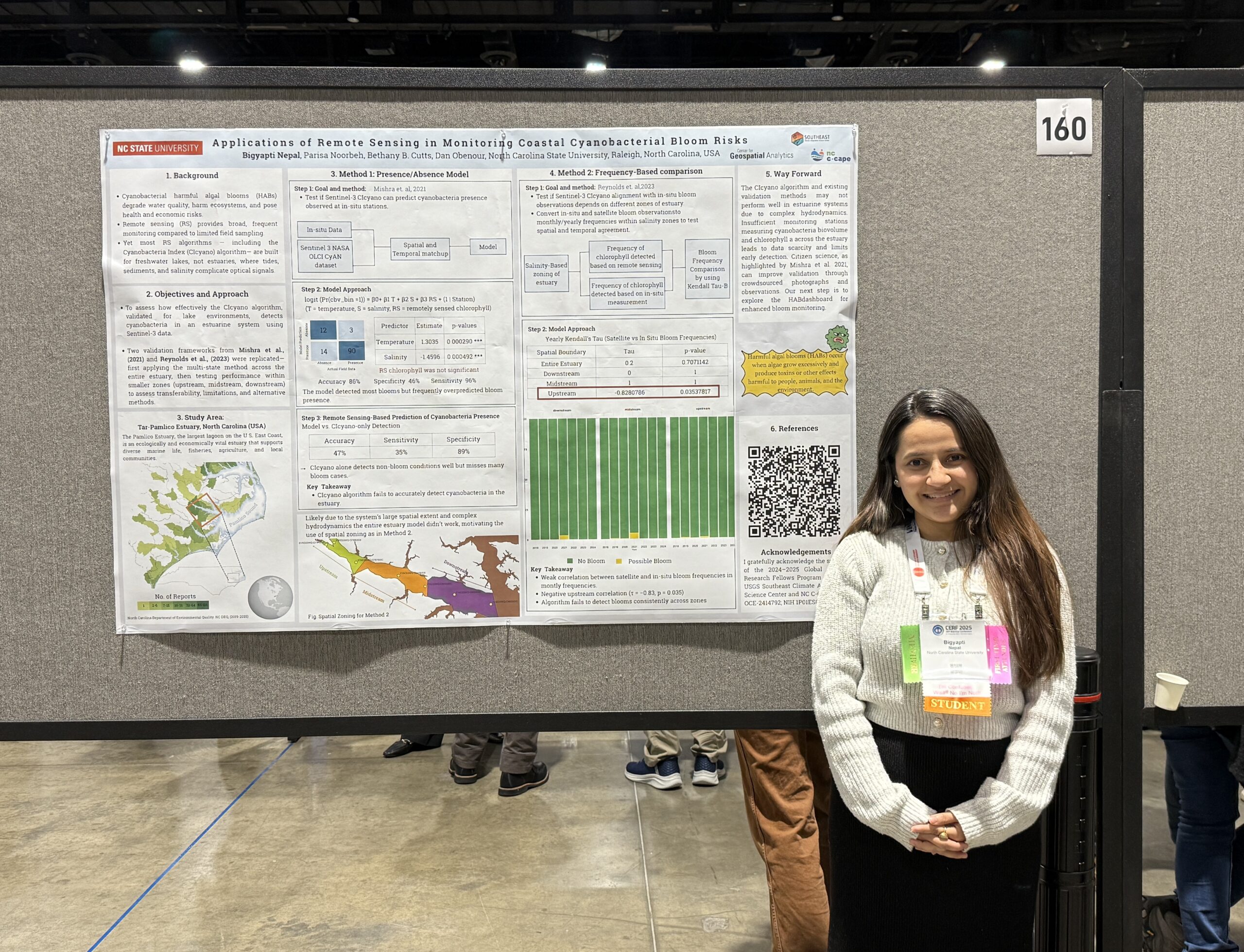
This year, I had the opportunity to attend the Coastal and Estuarine Research Federation (CERF) Biennial Conference in Richmond, Virginia from November 9th- November 13th, and to present my Ph.D. research in person for the first time. Thanks to the Travel Award from the Center for Geospatial Analytics, I was able to share my work, meet experts from across the country, and gain new perspectives that will shape my future research.
My presentation focused on the potential of remote sensing to monitor cyanobacterial bloom risks in coastal environments. Specifically, I’m investigating whether an algorithm originally designed for detecting harmful algal blooms in lakes can be applied reliably to estuaries dynamic areas where freshwater and saltwater meet. My work centers on the Albemarle-Pamlico Sound in coastal North Carolina, the second-largest estuary in the United States. This system supports valuable ecosystems and local economies, but it is increasingly threatened by harmful algal blooms that can damage fisheries, tourism, and water quality.
At CERF, I shared early findings from my work testing how well this inland-water algorithm performs in the estuarine context. Estuaries present unique challenges: the water is more variable, optical conditions are complex, and the signals detected by satellites can behave differently than they do in lakes. My goal is to understand whether we can adapt existing tools or whether new, estuary-specific approaches will be needed for coastal bloom monitoring.
As a first-time attendee, I found the conference incredibly energizing. I met scientists from a wide range of backgrounds; ecologists, modelers, oceanographers, and environmental managers, whose questions pushed me to think critically about my next research steps. Several attendees asked how community and stakeholder perspectives might shape the way I frame my research questions. Others raised possibilities for connecting remote sensing with field monitoring or management decision-making. These conversations helped me see where my work fits into the broader effort to protect coastal ecosystems.
I was especially encouraged by the interest from researchers at other universities and from state and federal agencies. A few expressed enthusiasm about potential future collaborations, particularly around data sharing and validating bloom detection methods. As someone still early in my Ph.D. journey, having that kind of feedback and support was incredibly motivating.
Beyond the scientific exchanges, experiencing a conference of this size for the first time was its own learning opportunity. Navigating sessions, engaging with new people, and presenting to a diverse audience all helped me grow professionally and personally. The exposure and connections I gained will continue to influence my work long after the conference.
- Categories: