Amazon Wildfires: Why They Happen and How to Stop Them

Each year, thousands of fires occur in Brazil’s Amazon rainforest. According to Brazil’s National Institute for Space Research (INPE), recent years have seen more than 100,000 fire detections annually, with a significant portion concentrated in the Amazon region.
In 2024, INPE recorded about 140,328 fires in the Amazon, the highest total in nearly 17 years. That included more than 2,000 active fires in the state of Roraima in February alone, roughly five times the usual number for that month.
Wildfires in the Amazon destroy homes and resources on Indigenous lands, endanger countless wildlife species by destroying habitats and release large amounts of smoke and pollutants that can reduce air quality and pose health risks in nearby cities and communities.
Understanding what drives wildfires in the Amazon is key to addressing their impacts. While some of these fires start naturally, most are linked to human activity. The following sections explore the activities driving the wildfires, their impacts and how they are being addressed.
What Causes Wildfires in the Amazon?
Wildfires in the Amazon are often deliberately set as a result of slash-and-burn agriculture, a practice in which farmers and cattle ranchers clear forested land by cutting and burning it to make room for crops and pasture.
“Farmers cut down trees at the end of the dry season and then burn them right before the rains start. This leaves a nutrient-rich layer of ash on the ground that provides fertilizer for crops,” said Erin Sills, the Edwin F. Conger professor in the Department of Forestry and Environmental Resources at North Carolina State University.
Sills, who has studied the impacts of deforestation and climate change in the western Brazilian Amazon for nearly two decades, said slash-and-burn agriculture is commonly utilized in the tropics during the dry season, which runs from June to August in the western Brazilian Amazon.
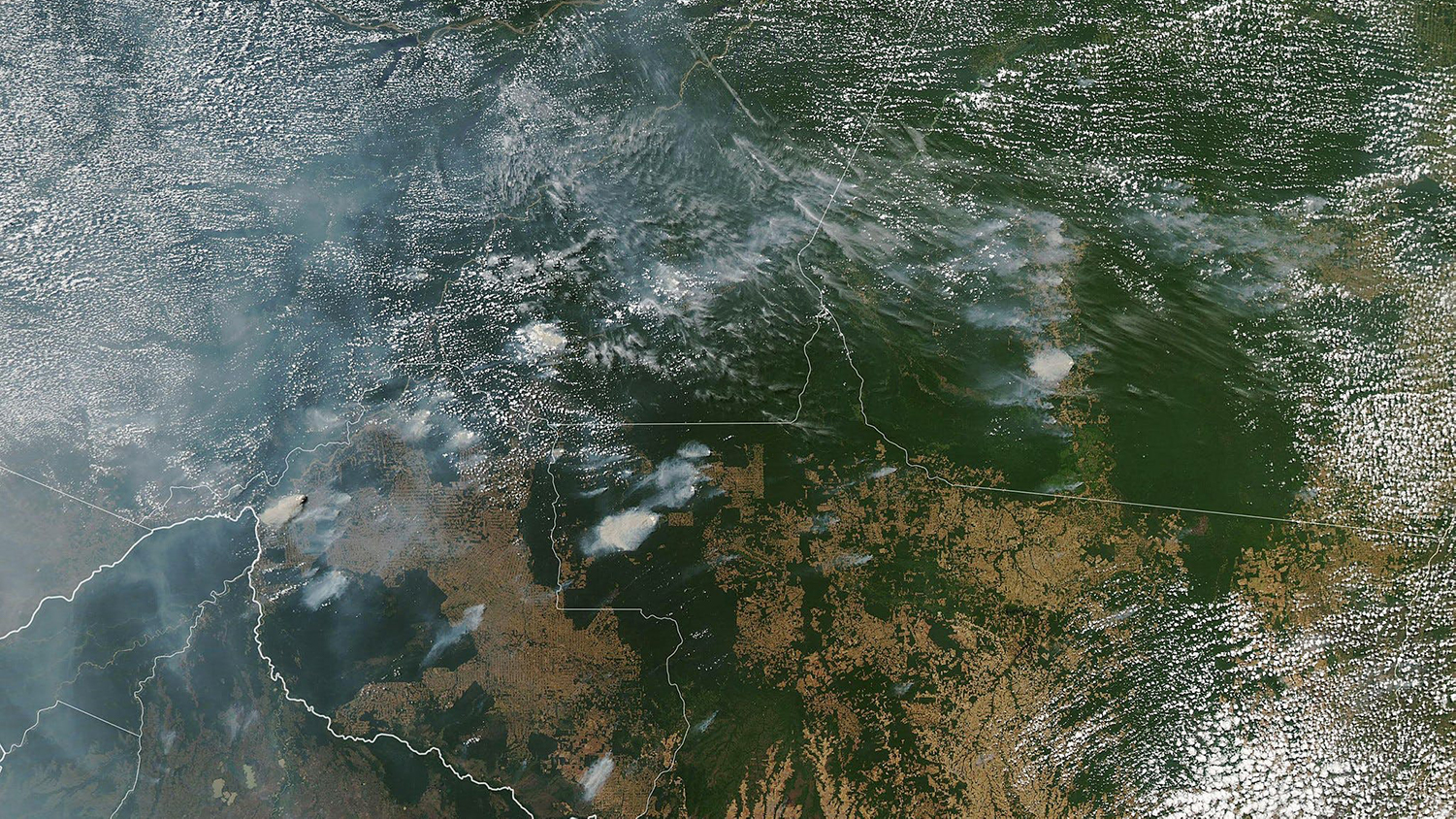
Broader increases in deforestation and fire activity in the Amazon have also been shaped by changes in government policies and enforcement, according to Sills. After a significant reduction in forest clearing in the Brazilian Amazon from 2004 to 2012, both deforestation and fire activity began rising again, peaking in 2019 when Brazil lost about 3,900 square miles of forest cover.
Critics attributed the increase to policies under then-President Jair Bolsonaro, whose administration limited the enforcement of environmental protections and reduced the budget of programs designed to monitor and prevent deforestation. During this period, Brazil lost more than 1,330 square miles of forest cover.
“There wasn’t a severe drought in the Amazon during that period, so the fires appear to have been influenced by the political situation in Brazil,” Sills said. “Landowners seemed to believe the government would not enforce environmental regulations, so they set fires without paying much attention to fire breaks or timing.”
What Are the Impacts of Wildfires in the Amazon?
Wildfires in the Amazon can be especially destructive because the rainforest evolved for millions of years without fire. Many of its plants and animals lack the adaptations necessary to survive high heat, making even relatively small fires potentially devastating to habitats and wildlife.
Beyond the immediate ecological damage, wildfires release carbon stored in trees, contributing directly to global warming. Trees in the Amazon absorb and store millions of tons of carbon dioxide each year. In fact, the rainforest in its entirety contains up to 200 billion tons of store carbon, functioning as a vital carbon sink.
“Trees release their carbon slowly back into the atmosphere as they die and decompose, but when they burn, that carbon is released immediately,” said Josh Gray, an associate professor in the Department of Forestry and Environmental Resources and Center for Geospatial Analytics.

When that carbon enters the atmosphere, it acts as a greenhouse gas, trapping heat and contributing to rising global temperatures. This warming can intensify droughts, fuel stronger storms and have a number of other effects that impact ecosystems, agriculture and human communities worldwide.
Sills said these consequences, while global in scope, are likely to have a more immediate and direct impact on the more than 30 million people, including 350 Indigenous and ethnic groups, who rely on the Amazon rainforest for food, shelter, clothing and even medicine.
Wildfires can worsen local conditions, altering rainfall patterns and lengthening dry seasons, putting agricultural productivity at risk as the warmer and drier conditions make it harder for the Amazon’s communities to grow crops and raise livestock.
How Can Wildfires in the Amazon Be Prevented?
Since taking office in 2023, President Luiz Inácio Lula da Silva’s administration has strengthened enforcement of environmental protections and reactivated programs to curb deforestation. These efforts contributed to the decline in fire activity in 2025 compared with the previous year.
Even with policy improvements, slash-and-burn operations produce heavy loads of burned material that fuel hotter, longer fires. These types of fires can be more difficult to control compared to wildfires, especially during periods of severe drought when vegetation is extremely dry and flammable.
Joseph Roise, a professor in the Department of Forestry and Environmental Resources who specializes in wildfire behavior, said the best way to prevent fires is to control deforestation and manage agricultural activities, while recognizing that slash-and-burn farming remains an economic necessity for many rural communities.
“The people in the Amazon are people like us,” Roise said. “They just want to farm their land and make enough money to survive with their families.”

Balancing rainforest protection with the needs of local communities remains a major challenge. Various programs and policies are underway to curb deforestation in the Amazon while supporting local livelihoods and sustainable forest management. That includes the Green Municipalities Program.
Established in 2011 by the State Government of Pará in Brazil, the Green Municipalities Program provides technical and financial support to municipalities to help them comply with federal and state deforestation targets while maintaining local economic activities such as agriculture and forestry.
A 2020 study led by Sills found evidence that municipalities that participated in the Green Municipalities Program were able to maintain higher levels of economic activity while complying with deforestation limits, showing that sustainable forest management and local economic growth can coexist.
Remote sensing offers a way to monitor these efforts by tracking forest changes over time. By combining satellite imagery with data on land use, researchers can assess the effectiveness of conservation policies and programs, such as timber concessions, in preserving rainforest.
Gray and Sills are already using this technology to track deforestation in Indonesia and hope to expand it to other tropical regions, including the Amazon, though they caution that remote sensing alone cannot capture local social, political and economic factors and requires input from those on the ground to fully assess policy impacts.
“Any pattern of deforestation requires an understanding of the context in which it’s happening,” Gray said. “We have to keep that in mind when drawing conclusions about why some policies work and don’t work.”


