Master of Forestry Program (Non-Thesis)
The Master of Forestry program at NC State is a professional degree for students pursuing careers in forest management with private companies, federal and state governments, and nonprofit organizations. The program — accredited by the Society of American Foresters (SAF) — prepares students to take the SAF-Certified Forester Exam and most other state registration exams, including the North Carolina Registered Forester Exam. Many employers expect foresters to become certified or registered within a few years.
Students enrolled in the Master of Forestry program enjoy a broad education in natural resource sciences that emphasizes an interdisciplinary approach to managing forest ecosystems focused on sustaining resources while integrating contemporary scientific knowledge with traditional ecological practices. The curriculum covers sustainable resource use, environmental stewardship and the economic and social impacts of forestry practices.
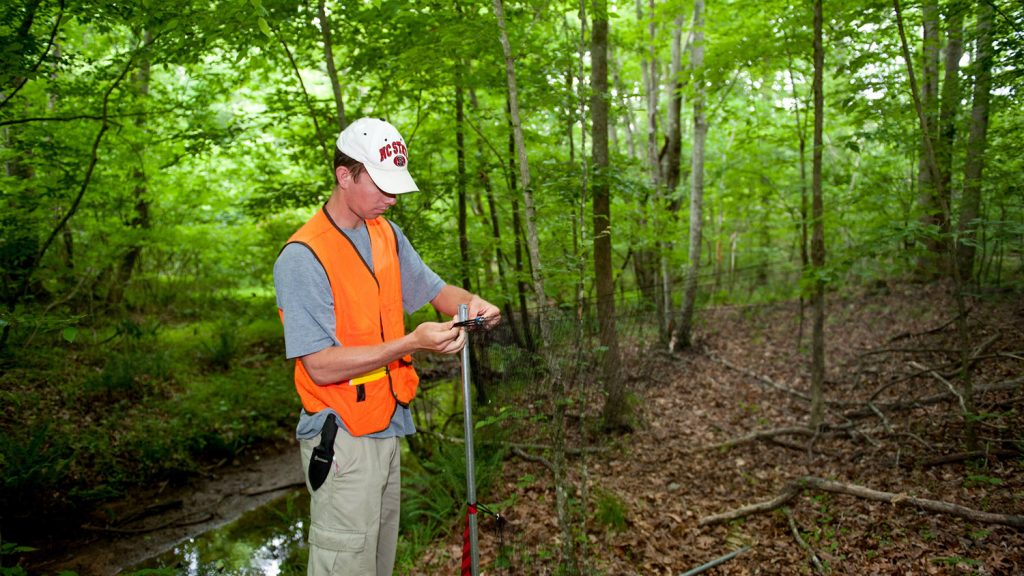
The Master of Forestry program combines foundational knowledge with experiential learning to prepare students for success in the field. Students gain a strong understanding of forest management by learning basic principles and applying research methods in our recreational and research forests, living labs and built spaces. They also participate in teaching, leadership development and professional outreach opportunities.
The Master of Forestry program is ideal for students with undergraduate degrees in natural resources or related fields, such as hydrology, wildlife management, plant biology, and environmental sciences. Students from non-natural science backgrounds are also encouraged to apply but may need additional coursework to meet SAF standards. Graduates with a bachelor’s degree in forest management from an SAF-accredited program are not eligible to apply. The average time to complete the degree is just over two years and the retention rate of students is 100%.
Key Learning Outcomes:
- Demonstrate a strong foundation in the basic and applied natural resource sciences.
- Demonstrate a breadth of academic experience across teaching, independent and collaborative research, grantsmanship, outreach, and leadership opportunities.
- Present research in peer-reviewed journals and conference papers at venues ranging from graduate seminars to professional meetings on local, national, and international levels.
- Participate in professional organizations by becoming members and attending meetings.
- Develop a comprehensive knowledge of the literature in their field of expertise and demonstrate that knowledge effectively.
- Define critical issues and generate relevant questions within their field of expertise.
- Apply appropriate research methods to chosen research questions.
- Understand the importance and limitations of their work.
- Effectively communicate research results in both oral and written forms.
- Demonstrate an awareness of current social, economic, and environmental issues in their field, and articulate the implications of their work in relation to these issues.
Career Opportunities
A master’s degree in forestry can lead to various career opportunities. In 2023, the median annual wage for foresters with a master’s degree was $67,330. Some potential career paths for graduates include:
- Certified Forester – Assess forests for timber sale, wildlife management, pest management, economic viability, and landowner goals. Recent employers include International Paper and Rayonier.
- Consulting Forester – Offer advice and services to private landowners about the sale of forestland, landscape planning, pest control, timber stand improvement, wildlife management, timber sales, and more. Recent employers include Weyerhauser and Georgia-Pacific.
- Extension Agent – Develop and deliver educational programs to assist with economic and community development, leadership, agriculture, and environmental issues. Recent employers include NC State Extension.
- Forest Management Specialist – Execute timber surveys, develop and maintain forest maps, analyze wildfire statistics and coordinate fire control, and provide technical consulting with industry and government. Recent employers include Carolina Tree Care and Hancock Forest Management Group.
- Forestry Technician – Conduct harvest preparation, reforestation, tree stand care, erosion control, and habitat improvement, in addition to planning, assessing, inspecting, and directing forestry projects. Recent employers include USDA Forest Service and C. Maynard Johnson Consultant Forestry.
- Service Forester – Conduct wildlife and natural resource management, enforce state and federal laws, develop and implement educational programs, fight forest fires, and provide emergency response when needed. Recent employers include NC Forest Service and Alaska State Department of Natural Resources.
- Timberland Appraiser or Procurement – Appraise, buy, and sell trees, forests, and forestland. Recent employers include J.W. Jones Lumber Company, WestRock, Timbco, and Hunt Forest Resources.
General Education Requirements
Students must meet the SAF general education competency requirements in (1) communications, (2) science and mathematics, and (3) social science and humanities through their prior coursework and degrees; by coverage in relevant forestry graduate courses; or by taking added undergraduate courses if necessary. Identified undergraduate competency deficiencies may require students to additional course work that will not count towards the Master of Forestry. Applicants will be evaluated and advised if any general education prerequisite courses are deemed necessary at time of admission.
Program Structure and Professional Project Requirements
Students in this program must complete 38 credit hours: 34 hours of traditional course work and 4 or more credit hours of electives are allowed. Traditional course work is approximately balanced among four categories: ecology and biology, measurement of forest resources, management of forest resources, and forest resource policy, economics and administration. Many courses have outdoor laboratories, where basic principles are applied to real-world situations.
Recognition of a subject matter competency can be given for any prior courses that meet the Recommended MF Course Display, but the total of 38 graduate credit hours required will be the same. Any prior undergraduate coursework that fulfills the same competencies will just allow more electives to be taken, not reduce the total number of graduate credit hours in the program. Graduate courses that meet NCSU transfer requirements and SAF competencies (e.g., from other universities, or NCSU post-baccalaureate studies) will be accepted with the approval of the advisor and the MF Coordinator up to the maximum number of credits allowed by the Graduate School. We also cooperate with the Duke MF program, which has relevant courses eligible to be taken for credit in our program through NCSU’s inter-institutional exchange program.
Students may write a management plan as their professional project. Other past student projects analyzed wood procurement systems, estimated growth and yield functions, assessed forest fire fighting systems, and analyzed effects of tree species introductions to the United States. Data for the project is normally collected in the summer. Click here for links to past student project reports.
Fall Admission Only in order to comply with prescribed course sequence.
Required Courses (38 credit hours)
Required courses are often offered only once each year, necessitating careful planning. The order shown below is recommended, but not required. Course titles followed by an asterisk (*) contain outdoor laboratories or assignments.
| Fall Semester (10 credits) | – FOR 501, Dendrology* – 4 credits – NR 560, Renewable Natural Resources Administration and Policy – 3 credits – FOR 574, Forest Measurement, Modeling, and Inventory – 3 credits |
| Spring Semester (10 credits) | – FOR 519, Forest Economics – 3 credits – FOR 504, Practice of Silviculture – 3 credits, and FOR 506, Silviculture Laboratory (Pines)* – 1 credit – FOR 506, Silviculture Laboratory (Pines)* – 1 credit; OR: FOR 508, Hardwood Management – 4 credits – FOR 534, Forest Operations and Analysis* – 3 credits |
| Summer Session I or II | Optional – Elective Course |
| Fall Semester (8 – 10 credits) | – FOR 505, Forest Management – 4 credits – Forest Disturbance Elective (1 out of 3 courses)** – 3 credits – Elective – 1 to 3 credits |
| Spring Semester (8 – 10 credits) | – FOR 572, Forest Soils – 4 credits – GIS 510, Fundamentals of Geospatial Science and Technology – 3 credits – Elective Course – 1 – 3 credits |
| Total | 38 Credits |
Course Notes
| ** Forest Disturbance Elective | – FOR 595-006, Forest Health Protection – 3 credits – Or FOR 531, Wildland Fire Science – 3 credits – Or FOR 595, Fire Ecology – 3 credits |
| Pre-Approved Designated Restricted Electives or Substitutions | FOR 630 Independent Study – Any Semester or Summer, 1-3 credits FOR 801 – Seminar, 1 credit §FOR 502 Forest Measurements or similar skills required * – 1 credit (Or NR 172 Or FOR 253 or equivalent natural resource employment field measurements competency is required) FOR 503 Tree Physiology – 3 credits FOR 508 Hardwood Management – 4 credits Or FOR 504 Practice of Silviculture – 3 credits FOR 506 (pines) Silviculture Laboratory * – 1 credit FOR 520 Watersheds and Wetlands Hydrology – 4 credits FOR 522 Consulting Forestry – 3 credits FOR 583 Tropical Forestry – 3 credits FOR 595-012 Consulting Forestry – 1 credit FW 404/FW 595 Wildlife Habitat Management – 3 credits NR 500 Natural Resource Management – 4 credits NR 554 Introduction to Data Analysis for Natural Resources – 3 credits NR 571 Current Issues in Natural Resources Policy – 3 credits PA 511 Introduction to Public Administration – 3 credits PB 565 Plant Community Ecology – 4 credits RED 501 Principles of Real Estate Development – 3 credits SSC 461 Soil Physical Properties and Plant Growth – 3 credits |
It is possible to take fewer courses per semester, although the degree must be completed within six years of the first course taken towards this degree. While a few of these courses can be taken online, most of the program courses require students to attend on-campus classes. For full course descriptions, please visit the course catalog.
Program Faculty
Faculty who often work with students include Joe Roise, Fred Cubbage and Jodi Forester. Students are encouraged to contact faculty directly about graduate opportunities and whether undergraduate course work satisfies the general education requirements.
Commitment to Student Support and Professional Ethics
Our college is committed to fostering an inclusive and supportive environment for all students, offering resources through the Office of Culture and Community Excellence to enhance a sense of belonging and provide guidance throughout their academic journey.
Additionally, we follow the SAF Code of Ethics, which serves to protect and benefit society by guiding members in their professional responsibilities.
This code inspires and governs our students and professionals as they navigate their careers in forestry and natural resources.