Jenna Kepnes – Going Green: Overcoming the “Black Thumb” with Compost
Before this summer I had never grown any plant successfully from a seed, and not for lack of trying. At Inter-Faith Food Shuttle, seed germination is one small part of their most imperative process: growing food. As the compost operations intern for this local nonprofit, it was my responsibility to turn that process into a cycle. Everyone has heard “farm to table” in one context or another, but what about table to farm?
Global food waste surpasses 2.5 billion tons annually, and–in the US–food waste takes up 22% of landfill space. As that food is compressed in landfills it releases methane via anaerobic decomposition, contributing to global warming. Composting conserves landfill space and redefines “waste” by giving tossed food new life as highly fertile soil, transforming the farm-to-table line into a circular economy. Before this summer I knew of small-scale compost, but had no experience with a compost facility at an agricultural or industrial scale. In my position at Food Shuttle, that changed pretty quickly!
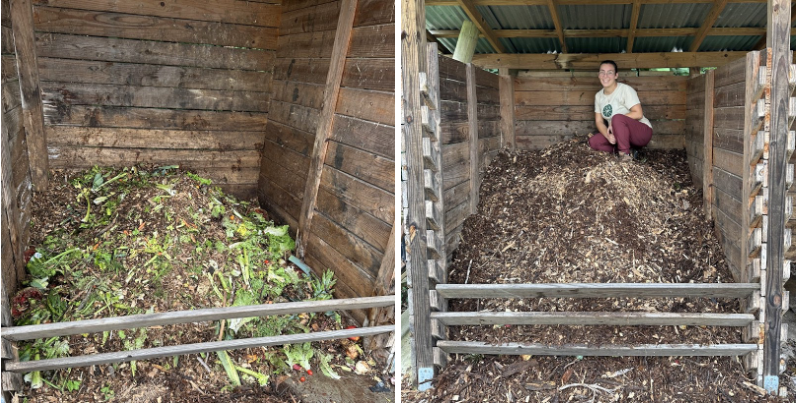
Any weeds, rotten produce and kitchen scraps can be incorporated into a compost pile. When mixed with dried leaves and woodchips and kept moist, this concoction becomes the perfect home for microorganisms to break down the complex molecules into available soil nutrients. Reaching temperatures above 150°F for days to weeks, any weed seeds or diseased materials in the pile are sterilized, ensuring that the end product gives way to healthy plants. In addition to developing record keeping and data analysis methods, leading volunteers in composting workdays and helping out around the garden, I conducted a germination test on each finished compost pile before it was deemed ready for use.
The germination test, or rather its results, quickly became one of my favorite tasks. As the organization’s first compost operations intern, I had freedom in my position to engineer and modify analytical methods, including germination tests. I planted zucchini, radish and cucumber seeds in samples of fresh compost and cared for them like my life depended on it. I wanted to make sure that my previously black thumb didn’t interfere with the determination of compost quality. With a sample size of 50+ like seeds per test, an 80% germination rate or greater indicated that the tested compost was safe and ready-to-use. As I conducted these tests throughout the entire summer, my experimental germination rarely lined up with planting season. With upwards of 40 sprouts per test, the next question was what to do with all these plants?
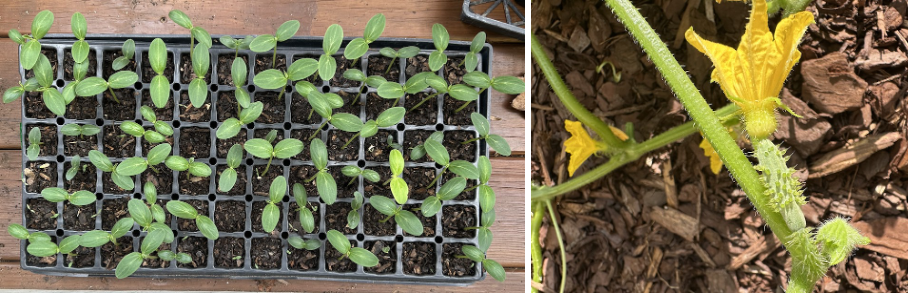
Some sprouts were planted at the learning garden, while others came home with me to start my family’s first-ever vegetable garden. We had been talking about giving the backyard landscape a refresh for a while, but not much had changed until I started regularly coming home with seedlings to plant. The zucchini plants flourished in the full sun, and every time a blossom popped up and a fruit started to form I would bring my parents and sister outside in excitement to take a closer look. Once I planted some cucumbers, tomatoes and bell peppers, my family began to match my enthusiasm in watching the tiny fruits mature into tasty snacks. Every time I think about the fact that these wonderfully fresh vegetables originated from a single seed in compost I had managed myself, I can’t contain my pride.
There have certainly been challenges in tending an at-home garden with limited experience (looking at you, squash vine borers), but my newfound passion for gardening and compost has driven me to learn more. My supervisor and coworkers at the learning garden were endlessly supportive in teaching me about agricultural methods and tasks, and I returned what I could in compost knowledge. Reading about compost methods and research allowed me to embrace my position with Food Shuttle as a subject matter expert, answering questions and leading thoughtful discussions about sustainability, composting and food waste during the volunteer sessions. Since Food Shuttle’s Compost Operations Internship hadn’t existed prior to this summer, the position evolved during my tenure. It was fun to have a hand in defining the role, and I made sure to record important responsibilities and regular tasks in a new SOP. The Compost Kitchen itself wasn’t operational between 2020 and April of this year, so rejuvenating the whole system was intense but worthwhile!
With both the IFFS Compost Kitchen and my at-home garden thriving, this internship offered a great balance of give and take. I learned so much, and know that my contributions to compost operations and education will continue in the organization with future interns. With my graduation approaching, I am eager to start my career in a place that allows me to mix hands-on environmental work with community education. When this growing season comes to an end, I know I will use what I learned this summer to convert all my garden “waste” into fertile compost for spring planting. And when this semester comes to an end, I will use everything I’ve learned over the past few years at State to keep waste out of our environment and diligently care for our natural resources.