Sage Boettcher: From Forest Streams to Biofilters
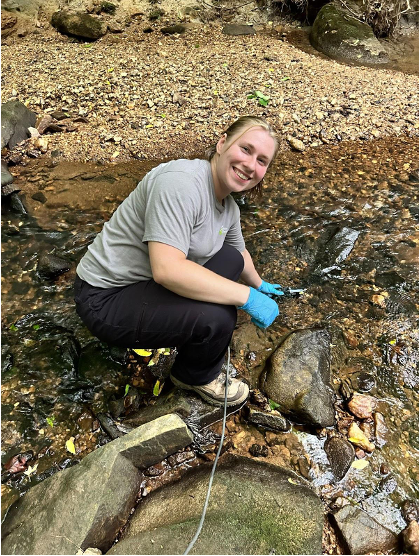
When I first set foot in the NC State Environmental Technology Management SURE Program, I envisioned a summer immersed in Schenck Forest’s tranquil streams, studying how urbanization impacts water quality. I expected to wade through creek beds, collecting samples and observing nature’s subtle responses to development. And for a while, that’s exactly what I did. But as the summer unfolded, my journey took an unexpected turn leading me into the fascinating world of stormwater biofiltration, mesocosm design, and nutrient cycling.
What started as a straightforward project assessing water in forest streams soon expanded into building and studying outdoor experimental systems known as mesocosms. These are essentially large outdoor tanks designed to mimic stormwater filters structures that treat runoff from urban areas before it reaches our lakes and rivers. Living and working with these mesocosms, I realized the importance of understanding how engineered systems perform under real-world conditions, especially when it comes to removing excess nutrients like nitrogen and phosphorus. These nutrients, when unchecked, can lead to harmful algal blooms, harming aquatic ecosystems and our drinking water sources.

One of my favorite moments was during a late afternoon sampling trip in the forest. While out taking a sample I ran into a snake hunting a fish in the water. It was so cool to see in person! I got experience using a YSI sonde, an electronic device that we used to measure water parameters like pH, conductivity, and dissolved oxygen. A YSI sonde is like a water’s health check-up tool giving us critical data to understand how natural waters respond throughout the day.
After Back at the stormwater research facility, I spent other afternoons troubleshooting pumps and collecting water samples from our mesocosms outdoor tanks filled with different biofilter materials like biochar, zeolite, and compost. These experiments aimed to see how well these materials could remove nutrients from stormwater. Working alongside Dr. Vinicius Taguchi and my graduate mentor Cael Nelson, I juggled engineering logistics, environmental monitoring, and teamwork.
Of course, it wasn’t all smooth sailing. Coordinating schedules with teammates sometimes proved tricky, and unclear instructions occasionally slowed progress. But these hurdles taught me resilience, learning to ask better questions, propose solutions, and adapt quickly. Each challenge was a stepping stone, helping me grow both as a researcher and collaborator.
Throughout the summer, I built a solid foundation of skills using advanced field equipment, conducting diurnal sampling (which means collecting water every few hours over a 24-hour cycle), and participating in nutrient-spiking events where we artificially increased nutrient levels to test system responses. These hands-on experiences deepened my understanding of how stormwater systems work to improve water quality.
One of my key moments was presenting our research at the SURE Symposium. Being able to share what I’d learned from two different projects and showcase the skills I developed felt meaningful, it’s about communicating the story of my work in a way that clarifies the science and sparks interest. By the end of the project, our data told an encouraging story: biochar and zeolite amendments demonstrated strong buffering capacity, helping stabilize pH and reduce nitrogen concentrations over time. Control treatments, which lacked amendments, showed less improvement, highlighting the potential of these materials. The variations between treatments underscored how different stormwater filter materials interact with water in complex, real-world conditions insights that could inform future biofilter designs.
This internship was more than just a research experience; it was a lesson in time management, independence, and knowing when to seek help. My supervisor, Dr. Angela Allen, remarked on my growing confidence and reliability, which meant a lot to me. As I head into the fall semester, I plan to take a policy course to better understand how science influences decision-making and regulation. I want to develop my data analysis skills further and explore how scientific research can shape policies for cleaner water in our increasingly urban world.
Looking back now, I realize how this unexpected journey reshaped my vision for the future. Research isn’t just about collecting numbers; it’s about curiosity, adaptability, and communication. Whether troubleshooting a pump at sunrise, logging complex data, or explaining my poster to an audience, I feel more prepared and inspired to pursue a career dedicated to designing practical solutions for water quality challenges.
- Categories: