Elsa Youngsteadt
EY

Associate Professor
Insect Ecology, Mapping a Dynamic Planet
Department of Applied Ecology
David Clark Labs 234
919-515-1661 [email protected] WebsiteBio
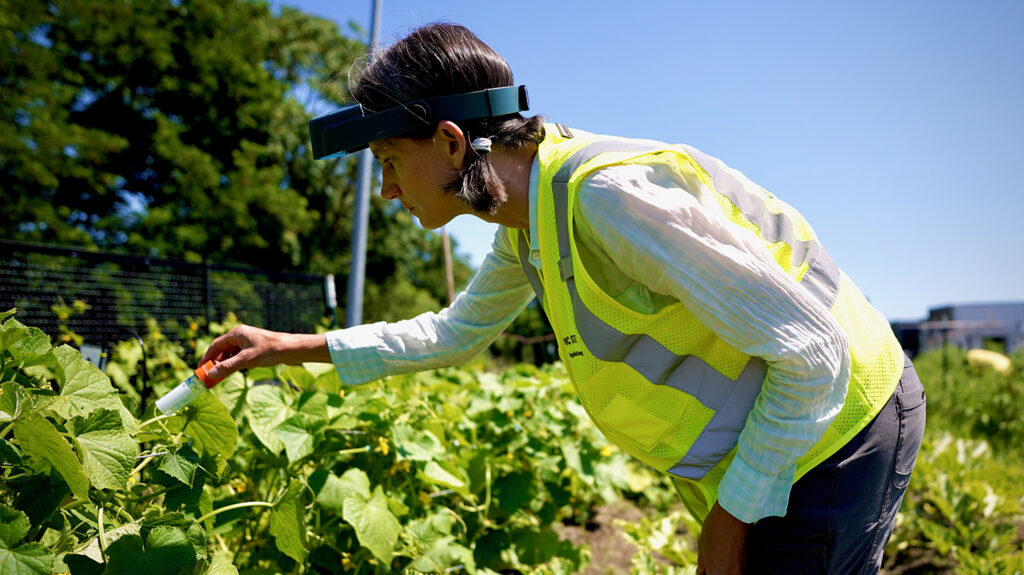
Elsa uses geospatial analytics to understand urban landscapes from an insect perspective. She combines ecological fieldwork with spatial models to evaluate resource accessibility and demographic processes in complex landscapes, ultimately informing the management of rare and beneficial insects. Other interests include thermal ecology and pollination biology, particularly in the context of urbanization and climate change.
Publications
- Colony Structure and Redescription of Males in the Rarely Collected Arboreal Ant, Aphaenogaster mariae Forel (Hymenoptera: Formicidae) , The Catalogue of Life (2026)
- Data from: To provide pollinator nesting habitat, cut dead perennial stems in their first winter , DRYAD (2026)
- Data from: Wealth does not buy richness: Plant and soil bacterial diversity in temperate suburban lawns are not influenced by income , DRYAD (2026)
- Defining the pollinator garden: is conceptual flexibility a feature or a bug? , Frontiers in Ecology and the Environment (2026)
- Nesting biology shapes climate vulnerability of social bees ( Bombus spp.) , Journal of Animal Ecology (2026)
- Nitrogen deposition interacts with water availability to influence herbivore abundance and herbivory on red maple ( Acer rubrum L.) , Royal Society Open Science (2026)
- Parasite hideouts: Preserving native cavity-nesting Hymenoptera through pollinator hotel management , PLoS ONE (2026)
- Thermal limits reveal asymmetric climate vulnerability across a solitary bee species' range , Zenodo (CERN European Organization for Nuclear Research) (2026)
- Thermal limits reveal asymmetric climate vulnerability across a solitary bee species' range , Zenodo (CERN European Organization for Nuclear Research) (2026)
- Tools for urban insect conservation: Zoning outperforms vegetative productivity as a predictor of insect biomass , Landscape and Urban Planning (2026)